When managing a website and digital marketing strategy, it is easy to end up with a long list of separate tools. One platform handles keyword research, another tracks rankings, a third analyzes website performance, while CRM, advertising, AI content, privacy, and customer support require even more software.
Bajorat Media Cockpit takes a different approach. Instead of positioning itself as a single-purpose SEO or marketing application, it brings more than 50 tools into one platform, covering SEO, GEO, Google Ads, AI, website optimization, CRM, lead generation, chatbots, privacy, and everyday business tasks.
The platform is particularly interesting for small and medium-sized businesses, freelancers, agencies, and website owners who want to manage more of their digital workflow without subscribing to dozens of individual services.
Bajorat Media Cockpit is available with a permanently free account, including monthly credits for selected analysis and AI tools. Additional credits can be purchased as a one-time purchase without a subscription, while a broader Pro offering is available for users who regularly need more capacity.
What Is Bajorat Media Cockpit?
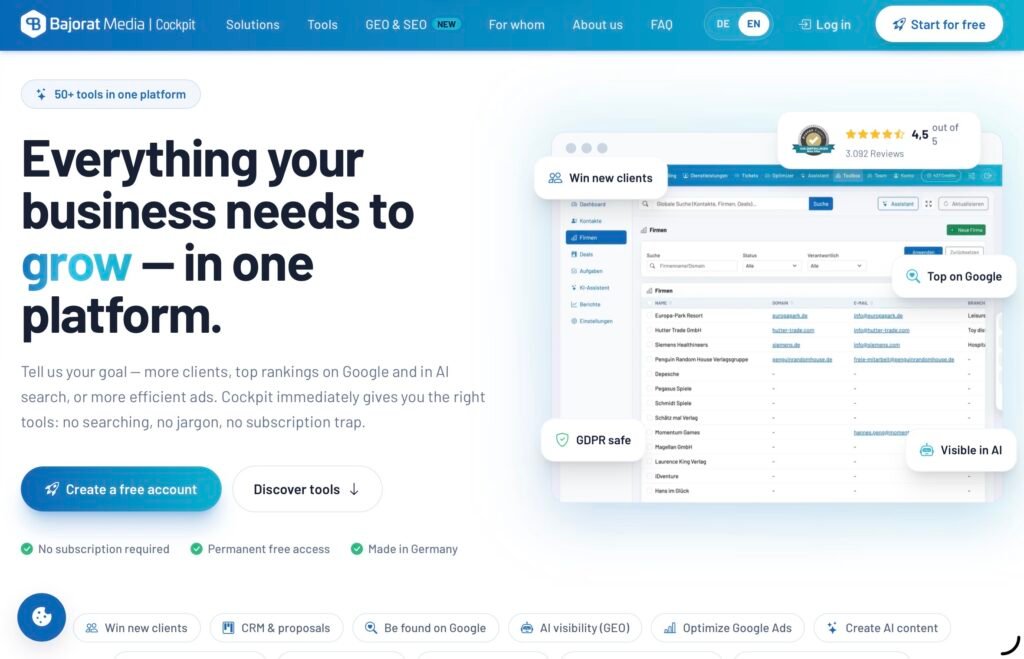
Bajorat Media Cockpit is a browser-based SaaS platform rather than a conventional WordPress plugin. It is essentially a digital marketing and business command center. Its strongest positioning is around SEO, GEO, and marketing, but the platform goes beyond search optimization.
Its toolset is divided into several major areas:
- SEO and AI visibility
- GEO and AI search optimization
- Website optimization and monitoring
- Google Ads analysis
- CRM and client management
- AI content creation
- AI chatbots
- GDPR and consent management
- Productivity
- Technical and email tools
The idea is straightforward: instead of moving between numerous dashboards, users can access different parts of their digital workflow through one account.
The platform describes itself as a solution for businesses that want to achieve more with fewer tools. That makes particular sense for smaller companies that may not have dedicated SEO, advertising, development, and sales teams.
Who Is Behind Bajorat Media Cockpit?
Bajorat Media Cockpit was developed by Bajorat Media, a German web design and marketing agency founded by Pascal Bajorat in 2006. The small specialist team works from Lippe and Berlin (Germany) and combines web design, custom WordPress and WooCommerce development, SEO and GEO, online advertising, performance optimization, maintenance, and AI integration.
The platform originated as a ticket system for the agency’s clients and grew from recurring needs in real website and marketing projects. This practical background remains part of the product: users can work independently with the tools, request expert support in Cockpit, or have Bajorat Media implement more complex website, SEO, advertising, and development tasks.
SEO: One of Cockpit’s Strongest Areas
SEO is one of the areas where Cockpit makes the strongest impression.
Alongside its AI SEO tools, the platform includes traditional SEO functions such as keyword research, ranking monitoring, competitor analysis, backlink analysis, domain keyword rankings, top-page analysis, live SERP analysis, and OnPage SEO analysis.
The OnPage SEO Analysis is particularly useful for website owners who need more than a simple score. Instead of presenting a long list of technical observations without context, Cockpit aims to turn findings into prioritized and understandable actions.
This can be valuable for small businesses that do not have an in-house SEO specialist. A report is much more useful when the website owner can understand what needs attention and which issues should be addressed first.
The Rank Tracker adds another important part of the SEO workflow. Users can monitor keyword rankings over time, including changes and competitor movements. This helps transform SEO from a one-time audit into an ongoing process.
For someone managing a WordPress website, this collection of browser-based WordPress SEO tools is especially practical. Instead of installing several plugins and connecting multiple external services simply to understand the site’s organic performance, Cockpit provides many of these functions from a centralized interface.
GEO and AI Search Visibility
One of the most interesting parts of Cockpit is its focus on GEO — Generative Engine Optimization.
Traditional SEO focuses primarily on search engine results pages. However, users are increasingly asking questions directly to AI systems and expecting answers rather than lists of links. That creates a new visibility challenge for brands.
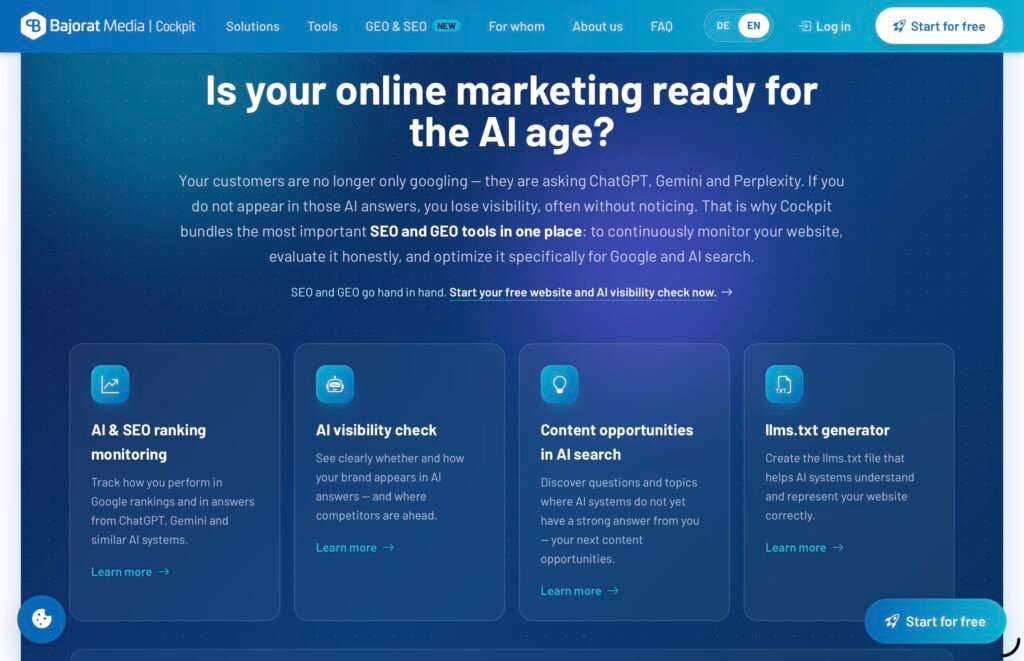
Cockpit addresses this with tools such as AI Visibility Check, AI & SEO Ranking Tracker, AI Search Content Opportunities, and an llms.txt Generator.
The AI visibility tools are designed to show whether and how a brand appears in AI-generated answers, including mentions and cited sources. This gives businesses another way to evaluate their online visibility beyond traditional Google rankings.
The AI & SEO Ranking Tracker is especially interesting because it combines conventional search visibility with visibility across AI answers. This creates a more comprehensive view of how a business is being discovered online.
The llms.txt Generator is another tool aimed at the emerging AI-search landscape. It creates an llms.txt file intended to help AI systems understand a website’s content and structure.
Of course, GEO is still an evolving field, and no tool can guarantee that ChatGPT, Gemini, Perplexity, or another AI platform will mention a business. What Cockpit does provide is a way to monitor and investigate this new type of visibility.
Google Ads Analyzer: A Practical Tool for Small Businesses
SEO is not the only area where Cockpit can help businesses save time and potentially money.
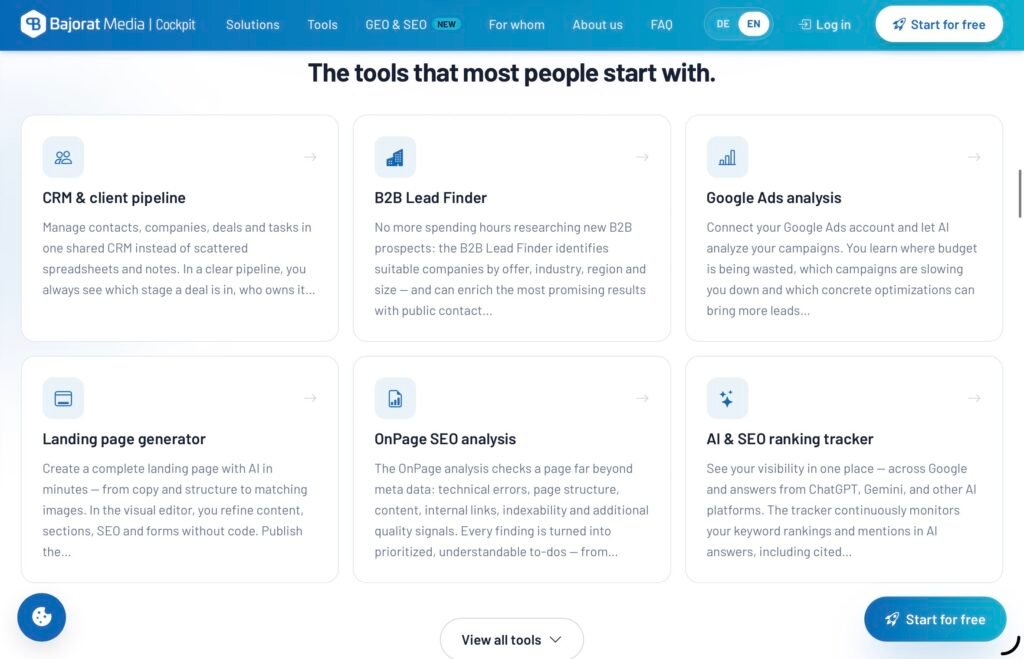
The Google Ads Analysis tool connects to a Google Ads account and uses AI to analyze campaigns. The goal is to identify wasted budget, campaigns that may be underperforming, and optimization opportunities.
This is particularly appealing for small businesses.
Google Ads can become complicated quickly. Campaign structure, targeting, keywords, bidding, conversions, and budgets can make it difficult for a business owner to understand whether their advertising is actually working.
For teams managing campaigns themselves, Cockpit can provide a useful first layer of analysis before specialist support is required.
Cockpit does not eliminate the need for expertise in every situation, but it can turn a dashboard filled with metrics into recommendations intended to highlight the areas that deserve attention. If strategy or implementation becomes more complex, users can also request support from Bajorat Media directly through the platform.
For businesses already spending money on Google Ads, this could be one of the most valuable tools in the Cockpit ecosystem.
Website Optimization Tools Beyond SEO
A good SEO strategy is not limited to keywords.
Website performance, technical errors, broken links, Core Web Vitals, security, accessibility, and privacy can all affect the quality of a website.
Cockpit’s Website Optimizer & Monitoring section brings several of these checks together. The platform can crawl a website, identify issues such as broken links and performance problems, and incorporate Google Search Console data into its analysis.
There are also dedicated tools for PageSpeed and Core Web Vitals, WordPress security, sitemap validation, and other technical checks.
For WordPress users, this broad approach is useful because website optimization often requires several different types of checks. Cockpit provides a centralized place to identify potential problems before they become larger issues.
Chatbot Manager for WordPress Websites
Another feature that deserves attention from the WordPress community is the Chatbot Manager.
The tool allows users to create an AI-powered WordPress chatbot and customize its appearance, behavior, knowledge, FAQs, and conversation starters. The chatbot can be used for customer support, sales assistance, lead qualification, or helping visitors navigate complex services.
The knowledge system is divided into components such as a base prompt, knowledge blocks, and FAQs. This makes it possible to give the chatbot structured information instead of relying on a single large prompt.
There are also more advanced options, including web search, allowed domains, webhooks, and MCP integrations.
For WordPress websites, Cockpit provides a WordPress integration option, making it possible to add the chatbot to a site without building the entire system from scratch.
This makes the feature particularly attractive to small companies that want an AI support assistant but do not want to develop their own chatbot infrastructure.
Free CRM for Small Businesses
Cockpit also goes beyond marketing into customer management.
Its CRM includes contacts, companies, deals, tasks, and a visual pipeline. The platform also includes a B2B Lead Finder and proposal functionality.
For a freelancer or small business, this can be surprisingly useful. Many small companies still manage leads through spreadsheets, email inboxes, notes, and separate task-management applications.
Having CRM and marketing information in the same environment means users can move from finding a prospect to managing the relationship and preparing a proposal without constantly switching platforms.
The free-access model makes this particularly interesting for SMBs that need basic CRM functionality but do not want to immediately commit to another paid CRM subscription.
GDPR and the Consent Manager
Privacy compliance is another area where Cockpit can be useful for European websites.
The Consent Manager (CMP) is designed to manage consent for cookies, analytics, marketing services, external media, and other third-party technologies. It includes categories for necessary, functional, analytics, and marketing services.
The CMP also supports presets for common configurations and integrates with Google Consent Mode.
For WordPress website owners operating in Europe, this is a particularly relevant addition. Rather than treating the cookie banner as an isolated visual element, the tool approaches consent as part of the website’s technical setup.
That said, businesses should still make sure their configuration matches their specific legal requirements. A CMP can help with implementation and documentation, but it does not replace appropriate legal advice or a properly configured privacy strategy.
AI Content Creation
Cockpit also includes a collection of AI-powered content tools.
Users can create AI-generated articles, edit text, generate images, create landing pages, and transcribe audio. The AI Landing Page Generator is particularly interesting for marketers who need to move quickly from an idea to a usable campaign page.
The platform’s AI Assistant takes this one step further by connecting information from different areas of Cockpit. According to the platform, it can work with data from CRM, SEO, rankings, website analyses, and other tools to generate briefings, drafts, or tasks.
This is an important distinction from using a generic AI chatbot. The value comes from having AI work with business-specific information rather than starting from an empty conversation every time.
Is Bajorat Media Cockpit Worth Using?
Bajorat Media Cockpit’s biggest advantage is not necessarily that every individual tool will outperform a specialized competitor.
Instead, its strength is breadth and integration.
A business owner can research keywords, monitor rankings, check website performance, analyze Google Ads, monitor AI visibility, manage leads, create proposals, build a chatbot, and handle consent management from one platform.
That makes it especially appealing to:
- Freelancers and solo entrepreneurs
- Small and medium-sized businesses
- WordPress website owners
- Marketing teams
- Agencies and web designers
- Businesses experimenting with GEO and AI search
The permanently free account also lowers the barrier to entry, with the platform offering monthly credits for AI and analysis tools without requiring payment details or a trial deadline.
Final Verdict
Bajorat Media Cockpit is an ambitious all-in-one platform that combines SEO, GEO, advertising, AI, website optimization, CRM, and business tools under one roof.
Its strongest value proposition is for users who currently rely on multiple disconnected tools. The SEO and GEO features make it relevant for businesses trying to improve visibility on both Google and AI search platforms, while the Google Ads Analyzer adds practical value for smaller advertisers that may not have access to a dedicated PPC specialist.
For WordPress users, the Chatbot Manager and Consent Manager are two particularly interesting additions. The first can turn a static website into a more interactive customer-support and lead-generation channel, while the second addresses an important aspect of running websites for European audiences.
There is also an important benefit to having CRM and marketing tools in the same environment. For small businesses, the difference between “marketing software” and “business software” can be unnecessary complexity. Cockpit attempts to bring those workflows together.
It is not a replacement for every specialized SEO, advertising, CRM, or development platform. Advanced users and large teams may still require dedicated tools for specific tasks. But that is not necessarily the point.
For freelancers, SMBs, marketers, and website owners who want SEO + GEO + advertising + AI + CRM + website tools in one place, Bajorat Media Cockpit is worth exploring.
With a free account available, there is little barrier to testing the platform and identifying which of its 50+ tools can actually fit into your workflow.
Click here for more.