Creating consistent SEO content is one of the biggest challenges for small businesses. You need to research keywords, plan topics, write articles, optimize metadata, add internal links, find images, publish everything, and then repeat the process again and again. For a small team, that can quickly become a full-time job.
Soro takes a different approach. Instead of simply helping you write individual blog posts, it aims to automate much of the entire SEO content workflow. The platform can find keywords, generate SEO-focused articles, add images and internal links, prepare metadata, and publish content automatically.
The idea is simple: give small businesses a way to maintain an active, search-friendly blog without having to manually manage every stage of the process.
What Is Soro?

Soro is an AI-powered SEO content automation platform designed primarily for small businesses. Its main purpose is to put blog publishing on autopilot by handling tasks that would traditionally require an SEO specialist, content writer, editor, and publishing workflow.
Soro can research keywords and create and publish SEO articles every one to two days. Articles can include images, internal links, and metadata, allowing businesses to move beyond simply generating AI-written text and toward a more complete content publishing process.
This makes Soro particularly relevant for businesses that understand the value of organic search traffic but don’t have the time or budget to maintain a large content operation.
How Does Soro Work?
Soro’s workflow is built around automation. Rather than starting with a blank document and asking AI to write a blog post, the platform is designed to take care of several steps involved in maintaining an SEO blog.
The process generally revolves around:
- Finding relevant keywords
- Identifying content opportunities
- Generating SEO-focused articles
- Adding images to articles
- Creating internal links
- Preparing SEO metadata
- Publishing content automatically
The frequency is another important part of the platform. Soro is designed to publish articles every one to two days, which can help businesses maintain a consistent publishing schedule without having someone manually prepare every article.
For a small business owner, this changes the question from “How do I write more blog posts?” to “How much of my content operation can I automate?”
Soro’s Key Features
AI SEO Content Generation
Soro’s core feature is automated SEO article creation. The platform researches keywords and uses them as the basis for generating content designed for organic search.
This can be useful for businesses that know they should be publishing more content but struggle to consistently come up with topics and produce articles.
Instead of spending hours researching what to write about, businesses can use an automated workflow to continuously identify potential content opportunities.
Automated Keyword Research
Keyword research is one of the most important and time-consuming parts of SEO.
Soro incorporates keyword discovery into its automated content workflow. This means businesses don’t necessarily have to begin every article by manually researching search terms and deciding which topics could be worth targeting.
The advantage is particularly relevant for smaller businesses without a dedicated SEO professional.
Automatic Publishing

Creating an article is only part of content marketing. Someone still needs to format it, add the necessary SEO information, publish it, and maintain a consistent schedule.
Soro is designed to automate publishing as well. With articles generated and published every one to two days, businesses can maintain a more active blog without having to schedule each article manually.
For businesses that struggle with consistency, this could be one of Soro’s most practical features.
Images and Internal Links
Soro goes beyond plain AI-generated text by incorporating images and internal links into its articles.
Internal linking is particularly important because it helps connect different pages on a website and can make it easier for both visitors and search engines to discover related content.
Having this step included in the automated workflow reduces the amount of manual optimization required after an article has been generated.
SEO Metadata
Soro also includes metadata as part of the article-generation process.
SEO metadata helps search engines understand and display pages, so having it included in the workflow means users don’t have to treat optimization as an entirely separate task after an article has been created.
50+ Languages

Another notable feature is multilingual support. Soro supports more than 50 languages, with content written natively in those languages rather than simply translated from English.
This can be useful for companies targeting multiple countries or maintaining websites in different languages. For multilingual businesses, the ability to automate content creation across several languages could potentially reduce the amount of manual work involved in maintaining separate content strategies.
Who Is Soro For?
Soro appears to be primarily aimed at small businesses that want to grow their organic presence without building a large content or SEO team.
It could be particularly relevant for:
- Small businesses with limited marketing teams
- Local businesses trying to increase organic visibility
- Startups that need to produce content consistently
- Businesses already investing in paid advertising
- Companies working with marketing agencies
- Website owners who don’t have an in-house SEO specialist
The platform can also complement existing marketing efforts. Businesses don’t necessarily have to choose between SEO content and paid advertising. Automated organic content can work alongside paid campaigns, social media, or agency support.
Soro vs. Traditional Content Marketing
Traditional SEO content production involves several separate steps.
First, an SEO specialist researches keywords. Then topics are selected and assigned to a writer. The writer creates the article, an editor reviews it, and someone handles images, internal linking, metadata, formatting, and publication.
For larger companies, this process can make sense because they have the resources to maintain it.
For a small business, however, the cost and coordination involved can become difficult to justify.
Soro’s approach is to consolidate many of these tasks into one automated workflow.
That doesn’t necessarily mean human content teams are no longer useful. Rather, Soro addresses the repetitive parts of the process that can consume significant amounts of time.
How Much Time Can Soro Save?
Time savings are arguably Soro’s biggest selling point.
A business owner who wants to publish several SEO articles per week would traditionally need to spend time on research, writing, editing, optimization, and publishing, or pay someone else to handle those tasks.
Soro attempts to automate much of that workflow.
The actual time saved will depend on how much oversight a website requires and how closely the generated content matches the company’s standards. Businesses in highly specialized industries may still want a human expert to review important content before publication.
However, for businesses primarily looking for a scalable way to keep their blog active, automation can remove a significant amount of repetitive work.
What Results Can You Expect From Soro?
SEO results take time to develop, so businesses shouldn’t expect an immediate increase in traffic after publishing their first articles. Soro’s indicative timeline suggests several stages of organic growth: pages may begin indexing during weeks 1–2, impressions can start appearing around weeks 3–4, and the first clicks may arrive around weeks 4–8.
Traffic can begin developing during months 2–3, with the potential for compounding results from month 4 onward as more content is indexed and begins attracting search visibility.
These are indicative stages rather than guarantees. Actual results can vary depending on the website, industry, competition, existing authority, content quality, and search demand.
Is Soro Affordable for Small Businesses?
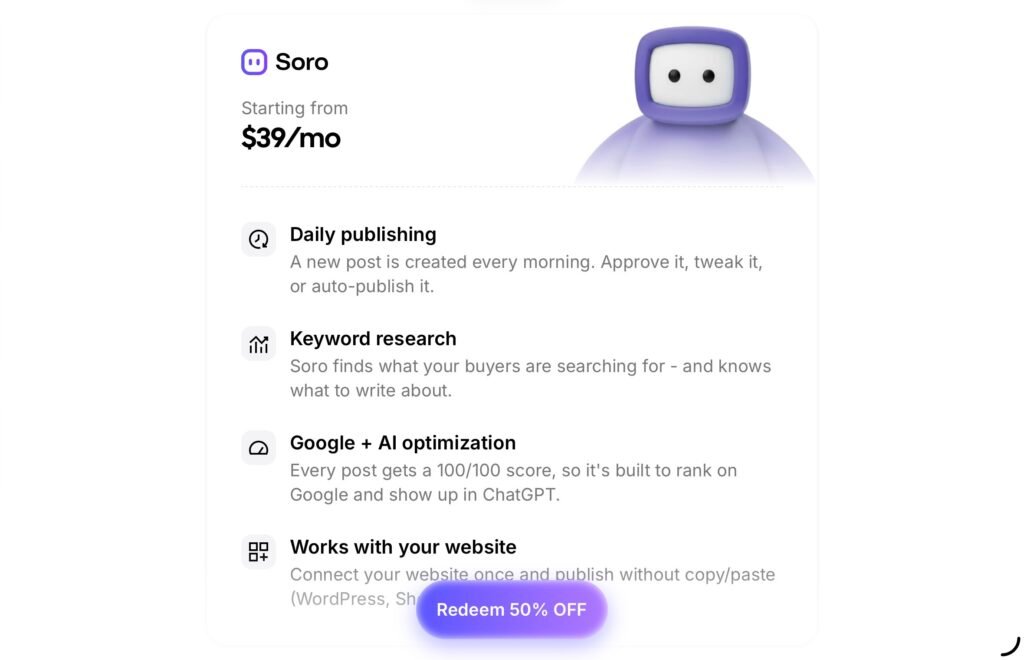
Cost is another area where Soro’s approach is particularly relevant.
Soro offers three billing options: $39 per month when billed monthly, $27 per month when billed quarterly, or $18 per month when billed annually.
Hiring a dedicated SEO specialist or maintaining a team of writers can be expensive. Even outsourcing content production can become costly when a company wants to publish consistently.
Soro positions itself as a more affordable way for small businesses to build organic traffic, particularly when compared with maintaining a larger content operation.
The value proposition is therefore not simply “AI writes blog posts.” It is the combination of keyword research, writing, optimization, images, internal linking, and publishing in a largely automated workflow.
Businesses should still compare Soro’s pricing with their current content-production costs and consider how much human oversight they require.
Soro Pros and Cons
Pros
- Automates multiple stages of SEO content production
- Designed for consistent publishing
- Includes keyword research
- Generates SEO-focused articles
- Adds images and internal links
- Includes metadata
- Supports 50+ languages with native-language content
- Can complement paid advertising and agency marketing
- Designed with small businesses in mind
Cons
- Soro does not build backlinks, as backlink building is intentionally outside its approach
- Each subscription covers one website
- Soro does not change or redesign your website
- Results build over a few months rather than appearing within weeks
- Automated content still needs appropriate oversight for some industries
- Businesses with highly specialized topics may require additional human editing
- The quality and usefulness of generated content can vary depending on the topic
- Fully automated publishing may not be appropriate for every brand
- Businesses should evaluate whether automation fits their existing SEO strategy
Soro Review: Our Verdict
Soro takes a broader approach to AI content than a conventional AI writing assistant. Its focus isn’t simply on helping someone draft an article. Instead, it attempts to automate the entire process surrounding SEO blogging—from finding keywords to creating, optimizing, and publishing content.
That makes the platform particularly interesting for small businesses that understand the long-term value of organic search but don’t have the resources to manage a large SEO content operation.
Its biggest advantage is convenience. Automating repetitive SEO and publishing tasks can free business owners and marketing teams to focus on other areas of their business.
At the same time, automation shouldn’t automatically mean zero oversight. Businesses should consider their industry, audience, brand voice, and the importance of accuracy when deciding how much content review is necessary.
Overall, Soro is positioned as a practical solution for businesses looking to make SEO content production more consistent without investing in a large content team. For companies that want to publish regularly while keeping the amount of manual work relatively low, its automated approach is worth exploring.
Click here for more articles.