A single typo, an inaccurate statistic, or a poorly structured sentence can significantly undermine the credibility of an otherwise excellent piece of marketing content. It does not matter how unique, useful, and valuable insights your content offers; small mistakes in it can reduce its overall effectiveness.
That’s why publishing content involves much more than simply receiving a well-written draft from the team and hitting the publish button. Marketers must perform a few important quality checks before making it live on the internet. This blog post is going to discuss five of the most crucial ones.
5 Key Quality Checks Marketers Should Perform Before Publishing Content
Below, we have discussed five important quality checks that every content marketer should perform before publishing.
- Search Intent and Audience Alignment

Before publishing content, marketers should carefully review it to make sure it matches the target audience’s needs and search intent.
This is crucial because even high-quality content may not produce results if it fails to meet the audience’s needs and search intent.
Now the question is: how can marketers check for search intent and audience alignment? For this, they have to review the content from an audience perspective.
They should ask themselves whether the content:
- Answers key questions
- Addresses potential concerns
- Provides enough information to the readers
They can also review competitors’ content on the same topic/keyword to determine what type of information readers expect.
Let’s say the topic is “What to Consider When Buying a Laptop.” This means the audience expects factors, laptop features, and other characteristics to consider before making the purchase decision. If the content covers these factors, it is more likely to align with the audience’s needs and search intent.
- Factual Accuracy of the Content
In marketing, accurate information is crucial for building trust with the target audience and maintaining content credibility. If the published content contains factually inaccurate stats, outdated information, or misleading claims, readers may start questioning the credibility of the entire write-up.
For this reason, it is considered an important quality check for marketers to verify all the factual data before making it live online.

Here is the approach that can be followed in this regard:
- Review each statement, statistic, research finding, and claim included in the draft. Also cross-check the data with the original source to make sure it confirms the same information.
- Make sure the mentioned stat is not outdated or irrelevant according to the content.
- Confirm whether the added external links are working and redirect to the right source.
To help verify claims that have already been investigated, marketers can use Google Fact Check Tool. It is free to use and helps users find fact-checks published by independent organizations.
- Readability and Structure
Imagine this: You and your team have spent several hours crafting an excellent marketing piece only to find out that the audience is unable to understand it due to poor readability and structure. As a result, your entire effort may go in vain.
Therefore, it is essential for marketers to consider both of these elements before publishing the content.
Here is how marketers can check for readability.
- Examine the overall flow of the content to make sure it is consistent in terms of writing tone/style.
- The word choice should be simple and easy to understand.
- The sentence structure should also be simple and fluent.
- The sentence length should be appropriate.
If you notice anything that isn’t up to the mark, do not hesitate to make edits. Additionally, tools like Hemingway Editor can help evaluate the overall readability score of content.
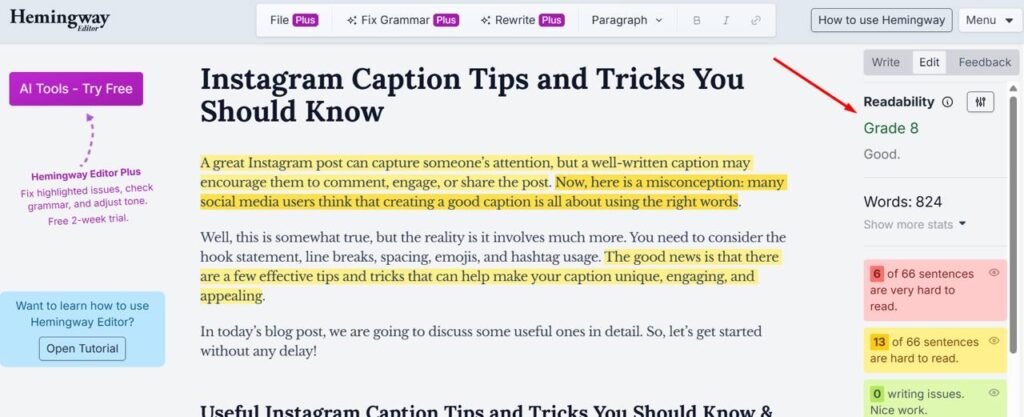
When it comes to structure, content should contain descriptive headings, short paragraphs, numbered lists, or bullet points. A good structure makes it easier for readers to skim through the content with minimal effort.
- Grammar and Spelling Accuracy
It does not matter how skillful a writer is; they can still make grammar or spelling errors. Publishing content with grammatical errors can not only reduce its effectiveness but also damage the business’s reputation.
So, before publishing content, do not forget to proofread it for grammar, spelling, and punctuation errors.
Now, here is a thing – many marketers manually read the content to find and fix errors, which is fine. However, this approach also has a risk that they may unintentionally skip or ignore some mistakes; this can be especially true for punctuation errors.
So, a better approach is to use the Grammar Check tool. It scans your text to identify many grammar, spelling, and punctuation errors. Users can fix mistakes one by one or fix them all in a single click.
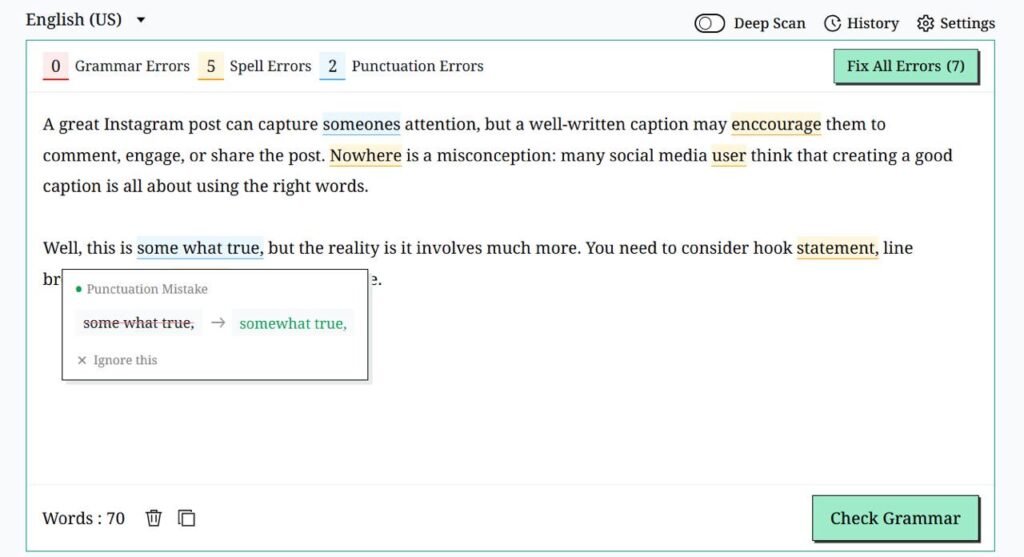
This way, marketers can not only make their content grammatically accurate but also save valuable time and effort.
- SEO and Metadata Optimization

Last but not least, marketers should review essential SEO and metadata elements before publishing the content.
For this, they should:
- Check whether the primary keywords naturally appear within the title, introduction, and body text. Avoid excessive repetition, as this is often considered “Keyword stuffing.”
- Determine the heading structure. Use an H1 for the main page heading, H2s for major sections, and H3s for subsections where appropriate.
- Review the title and meta description. Keep the title and meta description clear, relevant, and concise. Although there are no fixed character limits, search results may truncate them depending on the available display space.
- Look for internal and external links. The internal links should be highly relevant. External links should refer to credible and authoritative external sources.
SEO and metadata optimization can significantly increase the chances of your content dominating the search engine results.
Final Thoughts
As a marketer, you shouldn’t immediately publish the content after receiving the draft from the writing team. This is because it may contain potential mistakes such as inaccurate statistics, grammar errors, etc., that can damage the content’s overall effectiveness and the brand’s reputation online.
A better approach is to perform quality checks before hitting the “Publish” button. In this blog post, we have discussed five of the key content quality checks that can be considered in this regard.
We hope these checks help you review your marketing content more effectively before publishing.
Click here for more articles.