AI data labeling is an essential part of developing accurate and reliable machine learning models. Before AI systems can recognize objects, understand language, process speech, or make predictions, they need high-quality training data that has been properly labeled and organized.
AI data labeling platforms help businesses and AI development teams transform raw data, including images, video, text, audio, documents, and sensor data, into structured datasets that can be used to train and evaluate machine learning models. In 2026, these platforms are also increasingly using AI-assisted annotation, automation, human-in-the-loop workflows, and specialized expert teams to improve both speed and accuracy.
Below are five of the best AI data labeling platforms in 2026, each offering different capabilities for teams working on computer vision, natural language processing, generative AI, robotics, and other AI applications.
1. Labelbox
Labelbox is an AI data-centric platform designed to help organizations create, manage, and improve high-quality training data. The platform supports a wide variety of data types, including images, video, text, audio, documents, geospatial data, and medical data. It combines data labeling with data management, quality assurance, model-assisted labeling, and model evaluation.
Labelbox is designed for both individual AI teams and large enterprises that need to manage complex annotation projects. Users can create customized labeling workflows and define their own annotation structures depending on the requirements of their machine learning models.
What Makes Labelbox Different
One of Labelbox’s main strengths is its focus on the complete data labeling lifecycle. Instead of only providing annotation tools, the platform helps teams curate datasets, create labeling projects, monitor quality, and use model predictions to make annotation more efficient.
Its model-assisted labeling capabilities allow AI models to generate initial predictions that human annotators can review and correct. This can significantly reduce the amount of manual work required when labeling large datasets.
Labelbox also provides quality-control tools such as benchmarks, consensus workflows, and review processes. These features help teams identify inconsistencies and measure annotation quality before datasets are used to train models.
The platform is particularly useful for organizations working with computer vision and generative AI, while its support for multiple data formats makes it suitable for a wide range of AI projects. Businesses can also leverage AI development services to build customized solutions that integrate high-quality training data into their AI workflows.
Key Features
• Image, video, text, audio, document, and geospatial annotation
• Customizable annotation workflows and ontologies
• AI-assisted and model-assisted labeling
• Data curation and dataset management
• Quality assurance and consensus workflows
• Human-in-the-loop annotation
• Model evaluation capabilities
• API and developer integrations
• Enterprise data management and collaboration
Pricing
Labelbox offers different pricing options depending on the organization’s requirements, project scale, and features. Teams can choose solutions designed for smaller projects as well as enterprise deployments requiring larger-scale data operations and additional services.
2. Scale AI

Scale AI is a data platform focused on helping organizations build and improve AI systems through high-quality training data, data annotation, model evaluation, and AI development services. It supports a broad range of applications, including generative AI, computer vision, autonomous vehicles, and natural language processing.
The platform is designed for organizations that need to process large volumes of training data while maintaining high levels of accuracy and quality. Scale combines data annotation technology with a large network of human contributors and domain experts.
What Makes Scale AI Different
Scale AI stands out because it goes beyond traditional data labeling. Its platform is designed to support the broader AI development lifecycle, from collecting and preparing data to annotating it, evaluating models, and improving datasets based on model performance.
The company has also invested heavily in generative AI data services. These include human preference data, reinforcement learning from human feedback (RLHF), model evaluation, red teaming, and other workflows used to improve large AI models.
Scale AI also has strong capabilities for computer vision and autonomous systems. Its solutions can handle complex 2D and 3D data, including data generated by multiple sensors used in autonomous vehicles and robotics.
For organizations working on advanced AI applications, Scale’s combination of automated tooling, human expertise, data generation, and model evaluation makes it more than a traditional annotation provider.
Key Features
• Large-scale data annotation
• Image, video, text, and 3D data labeling
• Generative AI data services
• RLHF and human preference data
• Model evaluation and red teaming
• Computer vision annotation
• Autonomous vehicle and robotics data support
• Expert human-in-the-loop workflows
• Data collection and curation
• Enterprise AI solutions
Pricing
Scale AI offers pricing based on the type and volume of data, annotation requirements, and project scope. Enterprise customers typically receive customized pricing based on their specific AI data needs.
3. Shaip
Shaip is an enterprise-grade data labeling and annotation company that helps AI teams turn raw, unstructured data into model-ready training datasets. Unlike tool-only platforms that leave quality in the hands of anonymous crowds, Shaip pairs its annotation platform with a fully managed workforce of trained, domain-specialized annotators — giving AI builders both the software and the human expertise needed to label data accurately at scale. From computer vision and natural language processing to speech and audio, Shaip covers the complete annotation spectrum: bounding boxes, polygon and semantic segmentation, keypoint and landmark annotation, LiDAR and point-cloud labeling, named entity recognition, intent and sentiment tagging, audio transcription and segmentation, and specialized medical image and clinical text annotation.
What Makes Shaip Different
The company’s core USP is domain expertise built into the labeling process itself. Healthcare data is annotated by teams trained in clinical terminology; financial documents are handled by annotators familiar with regulatory language; conversational AI data is labeled by native speakers across a wide range of global languages. Every project runs through a multi-layer quality framework combining gold-set benchmarking, consensus scoring, and dedicated QA review — so accuracy is engineered into the workflow, not inspected in afterward.
Shaip is also at the forefront of Physical AI, one of the fastest-growing frontiers in machine learning. As robotics, autonomous systems, and embodied AI move from labs into the real world, they demand a new class of training data — egocentric video, sensor fusion, human motion and manipulation data, and real-world environment capture. Shaip already delivers end-to-end collection and annotation for these emerging use cases, positioning it ahead of traditional labeling vendors still focused solely on static datasets.
Key Features
- Full-stack annotation across text, image, video, audio, speech, and sensor data
- Managed, vetted annotator teams with industry-specific domain training
- Human-in-the-loop workflows blending automation with expert review
- Privacy-first delivery aligned with healthcare and enterprise compliance standards
- Physical AI and generative AI data support, including RLHF and model evaluation
Pricing
Shaip offers flexible, custom pricing based on data type, annotation complexity, and project scope — structured per unit or as dedicated-team engagements. Teams can request a consultation and pilot project to validate quality before scaling.
4. Acquirox
Acquirox is a managed AI data collection and labeling service built on a verified contributor network of 18M+ people across 150+ countries. Rather than selling annotation software, Acquirox delivers finished output: teams brief the task, and Acquirox handles contributor deployment, quality assurance, and delivery. The service covers custom data collection, POV and egocentric video datasets, raw dataset preparation and enrichment, and multimodal labeling across image, video, audio, and text, with structured output for model training, search relevance, recommendation systems, RLHF, and LLM evaluation.
What Makes Acquirox Different
Acquirox’s main strength is the scale and verification of its workforce. Every contributor is authenticated before a task reaches them, so data is produced by real people rather than bots, scraped sources, or synthetic generation, with documented provenance and contributor consent attached to dataset work.
Its egocentric and POV video collection is a notable specialization. As robotics, embodied AI, and physical AI move into real-world environments, they need first-person footage and human-action data that traditional labeling vendors don’t capture. Acquirox’s distributed contributors can record this at scale across diverse geographies, devices, and settings.
Quality is handled through a layered process: each item is cross-checked by two to three contributors, automated integrity checks run before human review, and senior Acquirox reviewers set the gold standard on flagged and edge-case items. Pilots are typically ready within 48 hours, so teams can calibrate contributors and review sample output before scaling.
Acquirox also works as a workforce layer for existing labeling platforms and annotation studios that have the tooling and clients but need contributor scale, plugging into their pipelines rather than replacing them.
Key Features
- Custom data collection and dataset enrichment
- POV and egocentric video datasets for physical AI and robotics
- Multimodal labeling across image, video, audio, and text
- RLHF and LLM evaluation data
- Multi-contributor cross-checking and expert review
- Documented data provenance and contributor consent
- Delivery in JSON, CSV, COCO, XML, or Parquet via API or export
- Workforce layer for third-party labeling platforms
5. Hive
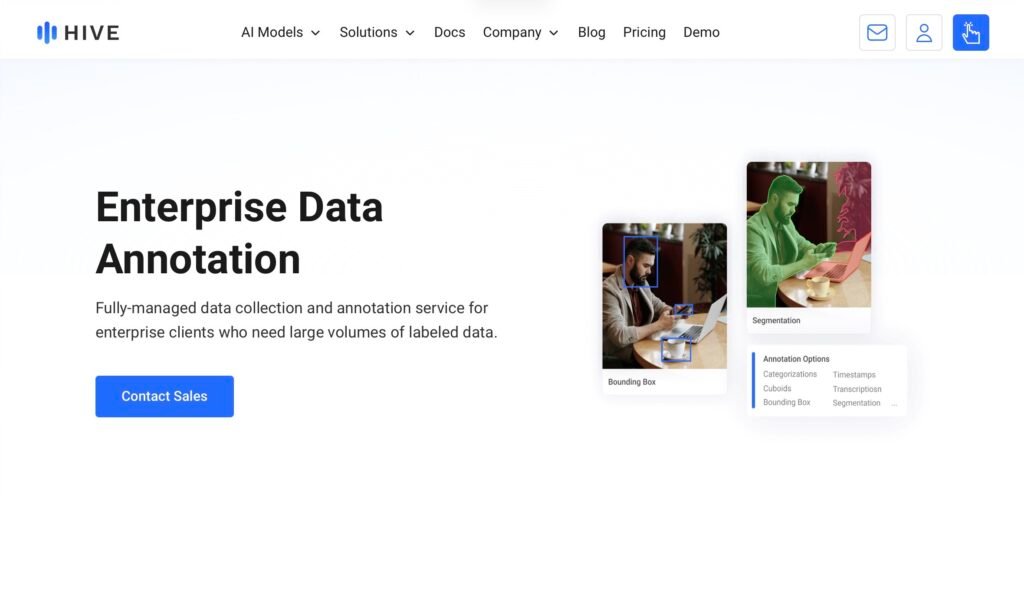
Hive is a data labeling and collection platform designed to provide organizations with large-scale, professionally managed training data. The platform combines data collection, human annotation, quality assurance, and a global workforce to help AI companies create datasets for machine learning applications.
Hive supports a variety of data types and projects, including image, video, document, and multilingual data. Its managed approach means organizations can outsource much of the workforce management involved in large annotation projects.
What Makes Hive Different
Hive’s main differentiator is its large distributed workforce and focus on managed data labeling at scale. Rather than requiring businesses to build and manage their own large annotation teams, Hive provides access to a network of contributors who can work on high-volume projects.
The platform uses multiple contributors and quality-control processes to help verify annotation results. This approach can be particularly useful for organizations working with very large datasets where manual management of every annotator would be difficult.
Hive also supports data collection in addition to annotation. This allows organizations to source new datasets and have them labeled as part of the same overall workflow.
Its ability to handle multilingual projects is another advantage for companies developing AI systems that need to work across different languages, regions, and markets.
Key Features
• Fully managed data annotation
• Large global labeling workforce
• Data collection services
• Image and video annotation
• Document labeling
• Multilingual data collection and annotation
• Large-scale dataset processing
• Human-in-the-loop workflows
• Quality assurance and result verification
• Enterprise data labeling services
Pricing
Hive provides customized pricing based on factors such as the type of data, annotation requirements, project volume, and level of service required. Enterprise customers can work with Hive to create a labeling and data collection solution tailored to their specific project.
Final Thoughts
AI data labeling has evolved significantly beyond simply drawing boxes around objects or assigning categories to text. In 2026, leading platforms are helping AI teams build complete data engines that combine human expertise, automation, quality assurance, data curation, model evaluation, and increasingly sophisticated generative AI workflows.
The right solution depends on whether your priority is flexible software, managed services, expert annotation, open-source customization, or massive operational scale. Before choosing a platform, consider your data modalities, annotation complexity, quality requirements, workforce model, integrations, security needs, and long-term AI development goals.
For enterprises building production-grade AI systems, investing in high-quality data labeling is not simply an operational decision—it is an important part of building better-performing and more reliable AI models.
Click here for more.