Let’s together find out the best marketing channels for WordPress plugins. Undoubtedly, the most important step for your plugin is to successfully launch it on WordPress. But what is the most influential and growth driving step to take? Yes, plugin promotion.
On WordPress.org your plugin is going to compete with thousands of plugins in its niche. Therefore, relying strictly on the official repository will limit plugin’s visibility, active installations and long-term user adoption.
To avoid all the above mentioned and boost your plugin’s visibility, high rankings and why not constant installs it is vital to increase WordPress plugin downloads outside WordPress.org.
Promote your plugin outside WordPress.org and meet users where they already spend time. This article breaks down one of the most effective and non-generic channels and top platforms to showcase WordPress plugins and effective plugin promotion outside WordPress.org.
Why You Should Promote Your WordPress Plugin on Best Marketing Channels for WordPress Plugins
As I have already mentioned, plugin promotion outside WordPress.org, is important and one of the most impactful ways to do that is via the WordPress plugin distribution channels.
Promoting your WordPress plugin on specialized marketing channels is necessary to conquer the highly competitive WordPress ecosystem. As a result, driving visibility, user accession, and plugin growth. A properly targeted marketing allows plugin developers or owners to move beyond the “product trap,” build brand authority, give the rise to valuable backlinks, and convert free users into paying customers, thus maximizing return on investment (ROI).
Key Reasons to Promote WordPress Plugin Beyond WordPress.org:
Succeed in Dealing With High Competition: With thousands of varieties, efficiently targeted marketing takes care of your plugin to stand out in the right audience.
Targeted Audience Exposure: Your plugin’s target audience is already in WP channels and communities searching for solutions. So, all you need to do is showcase your plugin as their solution.
Building Brand and Trust: Demonstrating success stories, good reviews, and detailed content demonstrates your plugin as a well founded and authoritative solution.
Driving User Growth: Effectious promotion boost free users conversion from the repository into premium customers, which is vital for revenue.
SEO and Visibility: Valuable content marketing and guest posts generate beneficial backlinks, improving your plugin’s web page’s authority and search rankings.
Direct Customer Feedback: Marketing efforts help to achieve plugin user’s reviews and feedback and as a result get better rankings and product improvements.
As has been noted, content marketing is one of the most worthwhile and powerful WordPress plugin promotion strategies when done strategically.
So, what to publish?
- Problem-first tutorials where your plugin is the solution
- Comparison articles (your plugin vs alternatives from the same niche)
- Use-case guides tailored to specific industries
Where to publish?
- Your own blog (primary SEO asset)
- Guest posts on WordPress-focused blogs
- Founder-led articles
This perspective grabs the attention of users who are already searching for solutions, thus making content one of the highest-converting channels over time. Using WordPress oriented channels guarantees that the effort contributed in development immediately translates into business growth rather than just having a technically good, but unknown, product.
Best Marketing Channels for WordPress Plugins
A small tip for you, when in future considering a WordPress marketing channel for your plugin, please note that the best marketing channels for WordPress plugins involve a multi-channel approach put together content marketing, email marketing, social media, Search Engine Optimization (SEO), and affiliate programs.
Now let’s check out what are the most effective WordPress marketing channels for your plugin growth.
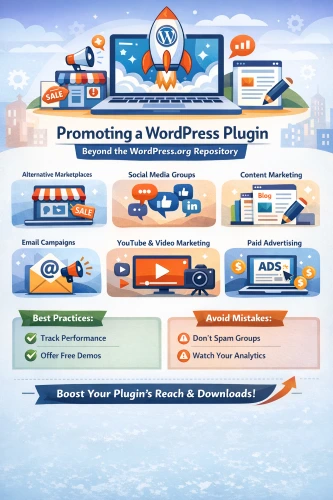
1. Social Media Platforms for WordPress Plugin Promotion
Use the platforms where your target audience is already active. This means they are already ready to build a community, share content, engage with users, and run targeted ads.
WordPress Blog LinkedIn and Twitter pages are one of the most effective social media platforms for communicating with other developers and B2B customers, while YouTube is great for video tutorials and demos.
Remember to participate constantly, answer questions, and do not be pushy, introduce your plugin only when it is a direct solution for the discussed issue. Hence, this builds credibility and avoids spam flags.
Lastly, social media works better when you conduct with value, not promotion.
Best platforms for plugin promotion:
- Facebook Groups (WordPress, freelancers, niche industries)
- LinkedIn (WordPress blogs, B2B plugins, SaaS-style tools)
- Reddit (subreddits like r/WordPress, r/ProWordPress)
- X / Twitter (developer-focused conversations, WordPress tips)
2. WordPress-Focused Blogs and Guest Posting
Create valuable content such as tutorials, guides, reviews, and blog posts that address your target audience’s problems and showcase your plugin as the solution outside WordPress.org. Find the best blog about WordPress and trust your plugin growth content to them. As a result, build authority and attract organic traffic from your potential customers.
3. YouTube and Video Content
Without a doubt YouTube and video content provide influential, visual promotion tools for WordPress plugins. WordPress YouTube tutorials will constantly drive engagement to your plugin, build trust, and installs. YouTube is one of the effectious platforms outside the WordPress.org repository for plugin promotion.
It is a fact that many WordPress plugin users tend to prefer watching rather than reading especially when evaluating plugins.
Here are effective video formats for your plugin visibility:
- Plugin walkthroughs and demos
- “How-to” tutorials solving specific problems
- Comparison and setup guides
Please note that optimized YouTube videos are very often ranking in Google results, creating an additional customer acquisition channel that synthesis over time.
4. Email Marketing and Newsletters
Creating an email contact list allows for direct, personalized communication with both leads and already existing plugin users. Utilize newsletters to share the latest updates, exclusive offers, and useful content, encouraging loyalty and driving sales.
Email marketing allows you to bring up plugin users before and after installation.
How to build your list?
- Offer free tools, templates, or mini-features
- Capture emails during onboarding or documentation access
How to use it?
- Product updates and feature education
- Use-case emails tailored to different segments
- Upgrade prompts for freemium plugins
Please note that Email consistently outperforms social media marketing in engagement and conversions rate when used properly and strategically.
5. Forums, Communities, and Webinars
Host live events or webinars to showcase your plugin’s value. In such forums you can answer questions in real-time, and generate leads. Hence, this interactive method of channel helps showcase the true benefits of your WordPress product.
6. Paid Promotion Channel
Use platforms like Google Ads or social media ads (Facebook, LinkedIn, etc.) to target particular demographics and keywords. As a result your plugin will be provided with a quick boost in visibility and user accession.
7. Influencer and Partnership Collaborations
Collaboration with WordPress influencers is also one of the plugin growth strategies that you can build. So, collaborate with established influencers, WordPress blogs, popular themes, or other non-competing plugins in the WordPress ecosystem. Therefore, this will significantly increase your plugin website reach and credibility within the community.
8. Affiliate and Referral Programs
Remember to always encourage existing users, influencers, and other businesses to promote your plugin in exchange for a commission. This forms a word-of-mouth marketing that can be highly effective and influential and cost-efficient.
9. Social Proof and Testimonials
It is also important to display your plugin users testimonials, ratings, and social proof notifications (e.g., recent purchases or sign-ups) to build trust and encourage conversions outside the WordPress.org repository. Learn how to get more plugin reviews.
Best Practices for Promoting Your Plugin Externally Via The Best Marketing Channels for WordPress Plugins
As you have already learned, promoting a WordPress plugin externally requires a combination of content marketing, SEO, and community engagement to boost awareness, win trust, and adoption.
Key channels involve crediting the official WordPress plugin directory, blogging/guest posting, social media marketing, and email marketing. Furthermore, essential practices include creating a dedicated landing page, providing high-quality support, offering a freemium model, and using influencer outreach.
So, these are the best practices for promoting your plugin externally:
- Use dedicated landing pages optimized for conversions
- Track performance by channel (not just total installs)
- Focus on use cases, not features
- Combine multiple channels instead of relying on one
Please note, growth comes from strategies, not single tactics.
Common Mistakes to Avoid While Reaching Best Marketing Channels for WordPress plugins
These are the common mistakes to avoid while contacting WordPress marketing channels:
- Relying solely on WordPress.org
- Spamming communities with direct links
- No paying attention to SEO and long-term content
- Failing to analyze which channels actually convert
Please note, avoiding these mistakes alone can significantly improve plugin traction.
To Sum Up The Best Marketing Channels for WordPress Plugins
To conclude all of the above mentioned information, if you want sustainable and constant growth for your plugin, the question is not about whether or not to promote it on alternative marketplaces for WordPress, it’s how strategically you do it.
By mixing proper content marketing, community engagement, email marketing, video marketing, and selective paid channels. As a result you will build compatible visibility, higher-quality consumers, and of course long-term success.